Skip to content

Are Solar Geysers Worth It? Before You Choose an Installer
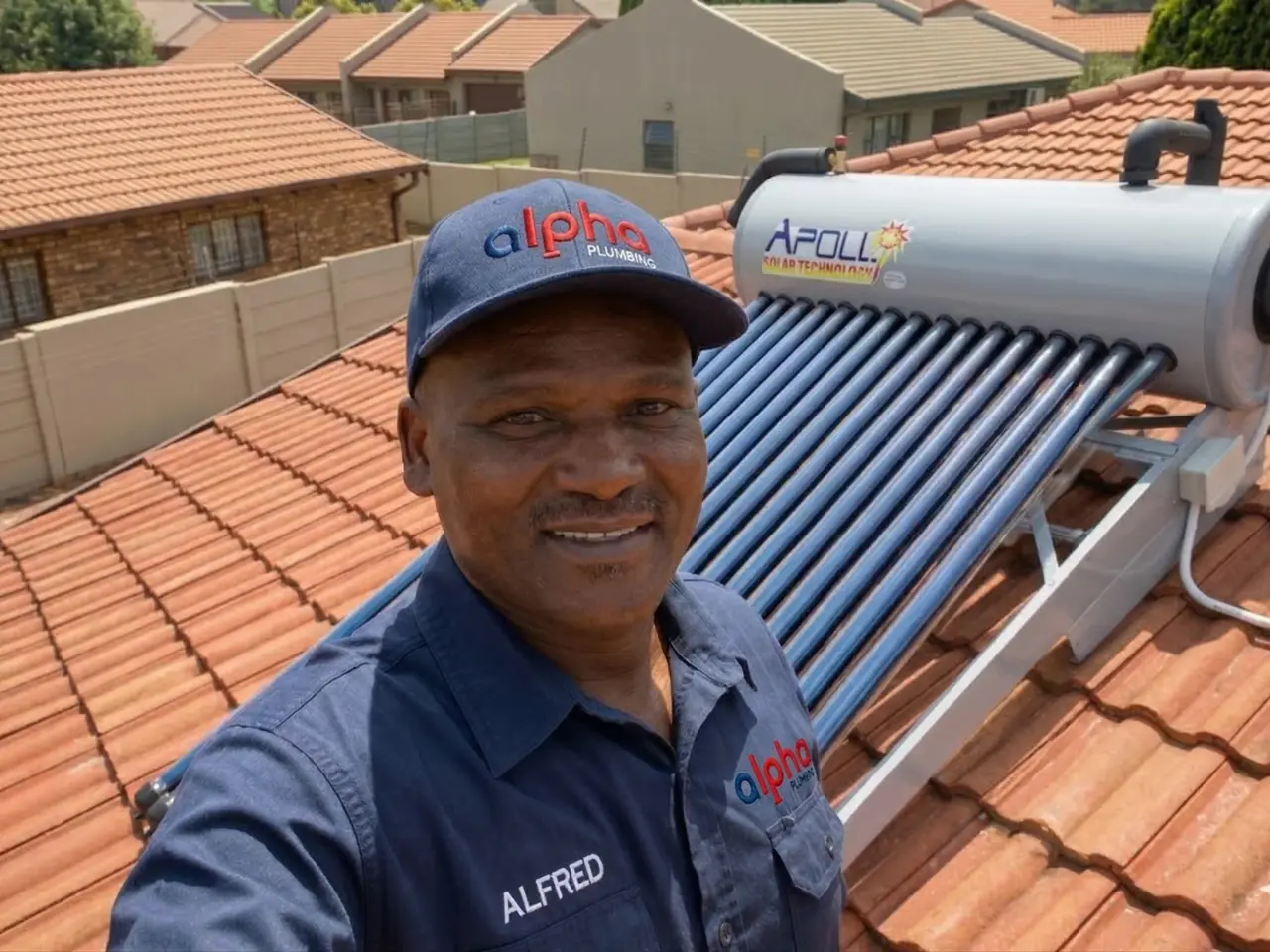
Are Solar Geysers Worth It? Before You Choose an Installer

Cut the Power Bill. Not the hot water.

With electricity bills continuing to climb, more Gauteng homeowners are looking at solar geysers as a smarter way to heat water. A correctly installed solar geyser can reduce your electricity costs significantly — but the wrong solar geyser installer or system can turn that investment into an expensive mistake. This guide covers solar geyser installation and what Gauteng homeowners need to know before choosing a system, hiring an installer, and staying compliant.

Alpha Plumbing is PIRB- and IOPSA-accredited and brings over 35 years of experience in solar geyser installations. Reach us on 010 001 8364 for expert solar geyser advice.

Why are more Gauteng homeowners searching for solar geyser installers?

The reason is simple: hot water is one of the largest electricity costs in the average home, and that cost keeps rising.

That frustration is real— and avoidable.

According to Eskom, a geyser can contribute up to 30% of monthly household energy usage. Other public guidance shows that in many middle- and high-income homes, the geyser is usually the biggest electricity user and can account for 40% to 60% of electricity costs, making it one of the biggest energy costs under your roof. 

Layer on top of that Eskom's sustained tariff increases. Electricity prices rose 12.74% in April 2025 and a further 8.76% from April 2026, both NERSA-approved—making every kilowatt-hour your geyser burns cost more than ever before.
Is a solar geyser worth it in Gauteng?

For most Gauteng homeowners, the answer is yes — but a few honest caveats deserve your attention before you commit.

Gauteng receives approximately 2,500 sunshine hours per year and an average of around 8 hours of sunshine per day, which makes solar water heating especially attractive in this region. That geographic advantage translates directly into a stronger return on investment compared to cloudier regions.

The financial case for switching to solar water heating becomes difficult to ignore. But a solar geyser installation should not be rushed. It does not deliver the same return in every scenario.

Three considerations determine whether a solar geyser makes sense for your home

Solar geysers require a meaningful upfront investment, which is why the long-term savings need to be weighed carefully. Public guidance puts payback for standard flat-plate close-coupled systems at around 3 to 6 years, depending on usage and financing, but that is a planning range, not a guarantee.

Whether a solar geyser is a worthwhile investment depends on your household’s hot-water demand, roof suitability, and system sizing. That is why a consultation with a qualified solar geyser installer should not be optional.

A practical rule of thumb is to have a minimum of 50 litres of tank storage per person, plus another 50 litres for the house. A system that is too small will lean more heavily on the backup electric element, while one that is too large may cost more upfront than needed. 

A north-facing roof is optimal, and uninterrupted sunlight is required. If the area is shaded between 9am and 3pm, another position should be found. A roof may look sunny from the garden but still be unsuitable.

A busy family home usually has more to gain than a lightly occupied property. If a household uses very little hot water, the savings may still be real, but the payback period will usually be longer. That is why the best solar geyser decisions are based on actual usage, not generic promises.

When searching for a solar geyser installer near me, it helps to understand these variables upfront. A qualified installer will assess all three before recommending a system, not after.

The savings potential is real — but only when the right system is matched to the right home. And as many Gauteng homeowners have discovered, load shedding adds yet another dimension to that decision.

The load shedding factor: why solar geysers make even more sense now

For homeowners in Johannesburg and Pretoria, load shedding is not a hypothetical risk. It is a daily scheduling problem. And nothing crystallises that frustration quite like stepping into a cold shower after a Stage 4 night.

Most solar geyser systems include an electric backup element — a heating rod inside the tank that tops up water temperature on cloudy days. That element runs on grid power, so it goes offline during load shedding.

However, the solar collector on your roof keeps absorbing heat from sunlight regardless of grid availability.

No electricity required.

That means a correctly sized, well-insulated solar tank that collected enough heat the previous day can often provide enough hot water to carry a household through a 24-hour period, even when the backup element is offline during load shedding.


Are Solar Geysers Worth It? Before You Choose an Installer

Not every home should get the same solar geyser. A site assessment helps you confirm roof suitability, hot-water demand, and the right system size before you invest. Speak to Alpha Plumbing about a solar geyser installation assessment in Gauteng.

Solar geyser, electric geyser, or heat pump: which is right for you?

Before locking in a decision, it helps to understand how solar geysers compare with electric geysers and heat pumps on cost and performance. Each comes with a different balance of upfront cost, running cost, and long-term value.

Understanding those trade-offs clearly—before you spend a cent—can save you from choosing a system that looks right on paper but works poorly in your home.

System TypeUpfront CostRunning CostLoad Shedding ImpactBest ForPayback Period
Solar GeyserHighLowestMinimal (daytime)Long-term savings, grid independence3–6 years
Electric GeyserLowestHighestFully disruptedShort-term or budget stopgapNo meaningful ROI
Heat PumpMedium-HighLowDisrupted without backupPoor roof orientation4–6 years

Solar geysers usually deliver the strongest long-term return. Running costs drop substantially because sunlight—not electricity—does most of the heating work. For homeowners planning beyond the short term, solar can be one of the smartest water-heating investments available.

Electric geysers have the lowest upfront cost, but they also carry the highest long-term running cost. The trade-off is complete dependence on grid electricity and ongoing exposure to rising power prices. 

Heat pumps use ambient air to heat water and, under ideal conditions, are 2–3 times more energy-efficient than conventional electric element geysers. That is a meaningful efficiency gain. However, they still require electricity to operate, so they cannot function during outages unless there's battery backup.

The recommendation framework is straightforward:

  • Solar geysers are often the best option for long-term savings.
  • Heat pumps are worth considering when roof orientation makes solar impractical.
  • Electric geysers are usually best considered a temporary or budget solution, not a long-term strategy.

Choosing the right system, though, goes deeper than just the technology category.

The specific type of solar geyser system matters enormously

Types of solar geysers: choosing the right system for your home

Not all solar geysers are built the same, and choosing the wrong system for your home can be an expensive mistake.

Before comparing quotes, it helps to understand what you are actually buying.

Flat-panel vs evacuated-tube collectors

Flat-panel (direct) systems use a panel of copper tubes bonded to an absorber plate. They are well matched to Gauteng’s high solar irradiation and handle moderate household demand reliably.

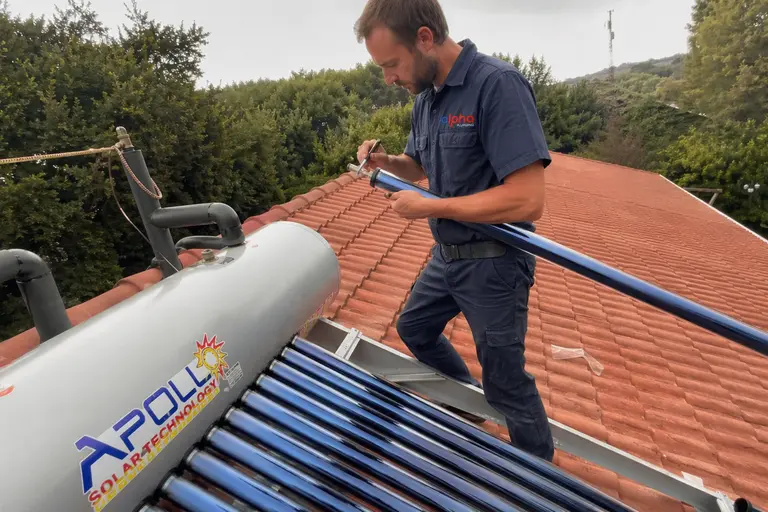
Evacuated tube systems use rows of glass vacuum tubes that retain heat more efficiently. They perform better on overcast days and during colder weather, but they usually come with a higher upfront cost.

High-pressure vs low-pressure

This distinction directly affects your shower experience.

Low-pressure systems rely on gravity feed and deliver lower water flow. That may be acceptable for some homes but frustrating for others.

High-pressure systems integrate with your existing municipal supply and deliver the same pressure you are used to. Many Gauteng homeowners do not ask about this upfront and only notice the difference when it is too late.

Direct vs Indirect: The Frost Factor

Gauteng winters are cold enough for frost, with Johannesburg averaging about 30 frost days a year and Pretoria approximately 16. That makes frost protection an important consideration when choosing a system.

Direct systems circulate household water through the collector, which can freeze and crack. Indirect closed-loop systems use a glycol-based fluid in the collector circuit, protecting against frost damage.

For many Gauteng properties, indirect systems are the safer long-term choice.

Tank Sizing and Roof Orientation

Are Solar Geysers Worth It? Before You Choose an Installer

Tank sizing is where many installations go wrong. The guideline of "50 litres per person + 50 litres for the house" is a starting point, but household hot-water habits, pipe run lengths, and backup element reliance all affect the right call.

A 150-litre tank for a family of five will lean heavily on the electric element, undermining your savings from day one.

Your installer should size the tank based on your actual usage profile, not a generic formula.

Roof orientation is assessed during the site visit. Your installer should confirm panel placement, angle, and any shading obstructions.

Solar Geyser Installation Costs: What to Budget in Johannesburg and Pretoria

Solar geyser pricing in Gauteng covers a wide spectrum, and where a quote lands on that spectrum usually reflects what you are getting.

At the lower end, you'll find offers that cover little more than a cylinder and a set of tubes. They look affordable until something goes wrong, a part needs replacing, or you discover the installation doesn't meet SANS standards. 

At the upper end, pricing reflects correctly specified components, professional installation, and the kind of workmanship that holds up over 10–15 years. 

Neither extreme is arbitrary — price and quality tend to move together in this industry.

What makes budgeting tricky is that a headline quote rarely tells the full story.

Several cost items are frequently left out of an initial quote and can catch homeowners off guard:

  • Structural roof modifications — older or tiled roofs sometimes require reinforcement or custom bracketing before a tank can be safely mounted
  • Existing plumbing upgrades — ageing pipes, corroded fittings, and worn isolator valves often need attention before a new system can be connected properly
  • Pressure and safety components — pressure relief valves and drain valves are non-negotiable safety requirements, not optional add-ons
  • Insulation — geyser blankets and pipe insulation improve system efficiency and are sometimes excluded from entry-level quotes
  • Electrical backup elements — if your system includes an element for cloudy days, the electrical connection and compliance work add to the total

A thorough installer will identify these requirements during a site evaluation and include them upfront. A quote that skips them isn't cheaper — it's incomplete.

The honest answer on price is this: a properly installed solar geyser system in Gauteng is a meaningful investment. Request itemised quotes from at least two or three PIRB-registered installers; compare what's included versus just the bottom line; and treat any quote that seems too good to be true with the scepticism it deserves.

What truly determines your return on investment isn't just the system — it's the quality of the person installing it. That critical point deserves its own conversation.

Get a transparent, no-obligation quote from Alpha Plumbing. Serving Sandton, Midrand, Randburg, Roodepoort, and Centurion.

How do you choose the right solar geyser installer in Gauteng?

Choosing the right installer matters more than many homeowners realise.

A solar geyser is only as good as its installation, and correct commissioning is not a formality. It determines whether your system performs safely and efficiently from day one. A poorly commissioned installation can reduce output, create safety risks, and affect warranty support.

Unqualified individuals offering solar geyser installations at tempting rates remain a real risk in South Africa.

For solar work, your installer should be aPIRB-registered Licensed Plumber with the relevant solar training and designation. That distinction matters because a PIRB Certificate of Compliance is tied to work done professionally and to standard as per the plumber’s training. You can — and should — verify any installer’s registration directly at pirb.co.za before signing anything.

Your installer should also be registered at the Institute of Plumbing of South Africa (IOPSA), which supports industry standards and professional accountability.

When unqualified work goes wrong, the consequences go beyond a poorly performing system:

  • Voided home insurance — insurers may reject claims where damage is linked to a non-compliant installation
  • Structural damage — incorrectly seated collector panels are a common source of roof leaks
  • Safety hazards — improperly configured pressure relief valves or thermostats can produce dangerously hot water

An unqualified installer does not just put your geyser at risk. It can put your home, your family, and your insurance cover at risk.

Are Solar Geysers Worth It? Before You Choose an Installer

Alpha Plumbing is PIRB- and IOPSA-certified and brings more than 35 years of experience with solar geysers, electric geysers, and heat pumps across Johannesburg and Pretoria. Every installation is approached with the correct technical standard, from system selection and roof suitability to compliant workmanship and final sign-off.

Want a qualified solar geyser installer to assess your home properly before you commit? Speak to Alpha Plumbing about a site visit in Johannesburg, Pretoria, or wider Gauteng.

How do you know a solar geyser installation was done properly?

Qualifications matter at the start of the job — but workmanship, commissioning, and compliance are what prove the installation was done properly.

A Certificate of Compliance (CoC) is an important part of that picture. It shows that the installation was completed professionally and to the applicable standard. For solar water-heating installations, the core solar installation standard is SANS 10106. Related standards may also apply depending on the system, including SANS 10142-1 for electrical work and SANS 10400-XA in the broader building energy context. 

While a CoC is not always described in exactly the same way in every municipality, it carries real practical weight. Many insurers may ask for proof of compliant installation when a claim is linked to a geyser or water-heating system.

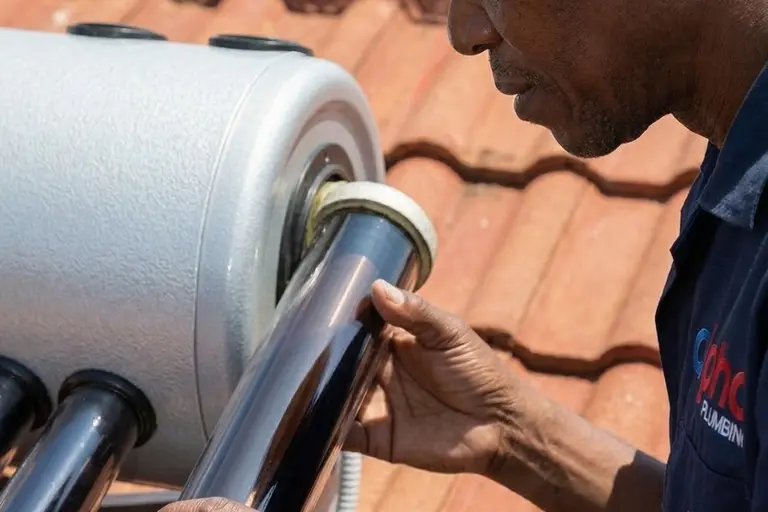
On installation day, small details matter. Look for neat copper pipework, secure roof bracketing, weatherproofed electrical connections, and no dripping fittings. Those details do not replace professional certification — but they do tell you a lot about the standard of the work.

Want to see what a professional Alpha Plumbing installation looks like? Call us on 010 001 8364, WhatsApp, or contact us online to book a site visit — no obligation. [Internal link: Get in Touch — https://alpha-plumbing.co.za/get-in-touch]

Frequently Asked Questions

A solar geyser is a water heating system that uses sunlight — not electricity — as its primary energy source. 

A solar collector (either flat-panel or evacuated tube) mounted on the roof absorbs heat from the sun and transfers it to water stored in an insulated tank. Most systems include an electric backup element that activates on heavily overcast days or during high-demand periods, ensuring you're never left without hot water. Unlike a conventional electric geyser, the bulk of the heating work is done by free, renewable energy.

Not without an assessment. The key requirements are a structurally sound roof capable of bearing the tank weight (a filled 200L tank can exceed 200 kg), a predominantly north-facing orientation for optimal sun exposure, and an unobstructed solar window between roughly 9 am and 3 pm. 

Tiled and IBR corrugated roofs are both workable, though each requires appropriate bracketing. 

A qualified installer will confirm suitability during a site visit and should flag any structural reinforcement needed before quoting.

A high-pressure indirect split system with a 200L–250L tank is often a practical choice for a typical 3-bedroom Johannesburg household.
The right sizing depends on the number of occupants and daily hot water demand, which a qualified installer should assess before recommending a unit.

A Certificate of Compliance is a formal document certifying that the work was completed professionally and to the applicable standard.

For solar water-heating work, the key point is not just that the plumber is registered, but that the work is carried out by someone with the relevant solar competence and training.

A CoC is often important for insurance, resale confidence, and proof that the system was installed properly.

In a direct system, household water circulates through the roof collector to be heated. 
In an indirect (closed-loop) system, a separate glycol-based fluid circulates through the collector and transfers heat to the household water via a heat exchanger.

The glycol fluid is frost-resistant, which is one reason indirect systems are often preferred in Gauteng—particularly in the elevated suburbs of Johannesburg and Pretoria, where frost is a problem.

Flat-panel collectors use copper tubes bonded to an absorber plate and perform reliably in Gauteng's high-UV environment. 
Evacuated-tube collectors use rows of glass vacuum tubes that retain heat more efficiently, particularly on overcast or colder days. Evacuated tubes generally cost more upfront, but they can outperform flat panels under tougher conditions.

Both can work well in Gauteng. The right choice depends on your budget, household demand, and site conditions.

Ready to Install? Here's Your Next Step

Choosing the right solar geyser comes down to three things:

  • matching the system type to your roof and household;
  • budgeting realistically for a quality installation;
  • and, most importantly, hiring a qualified installer who can stand behind the work.

Get those three right, and you are making a sound long-term investment.

Serving Johannesburg, Sandton, Midrand, Pretoria, Centurion, and surrounding suburbs, the Alpha Plumbing team brings 35+ years of experience, full PIRB and IOPSA certification, and 24/7 availability with no after-hours fees.

No pressure. No rush. We're here when you're ready.

Call Us: 010 001 8364